

Most often, it’s normal for a rib to stick out more due to hereditary and birth deformities. Unless you experience other negative symptoms, you wouldn’t have anything to worry too much about. A stuck-out rib can be caused by various medical conditions like scoliosis and trauma. If this is merely a slight deformity, you can help yourself overcome this situation by practicing exercises such as strengthening and stretching. Products such as yoga wheels and foam rollers too can help to go the extra mile in fixing your rib unevenness.
Body anatomy will always differ from person to person. So you shouldn’t be alarmed if you notice a side of your body bigger than the other.
This even applies to one rib, which may stick out unusually compared to the other.
However, since our ribcage is an essential structure in our body that protects the visceral organs from damage, we might need to pay more attention to its physical deformity, especially when some form of physical discomfort is part of that package.
Is it normal for one rib to stick out more? Why does one rib stick out more than the other?
What symptoms of medical conditions should you watch out for when it comes to your ribs? Are there exercises that might help even out your rib deformity? What products too can help in achieving rib evenness?
Is it normal for one rib to stick out more?
Nobody has a perfectly symmetrical body. For example, you might randomly notice that one of your ribs has been sticking out unevenly from the other throughout your life.
This may be an anatomical variant, and it’s completely normal. So unless you feel any discomfort from it, you don’t have anything to worry about.
This uneven form can be hereditary and is often referred to as a flared rib.
However, an uneven ribcage can also be unnaturally caused, which we must watch out for as it could cause problems with our posture and breathing.
Why does one rib stick out more than the other?
Various possible medical conditions may cause your rib abnormality, as listed below.
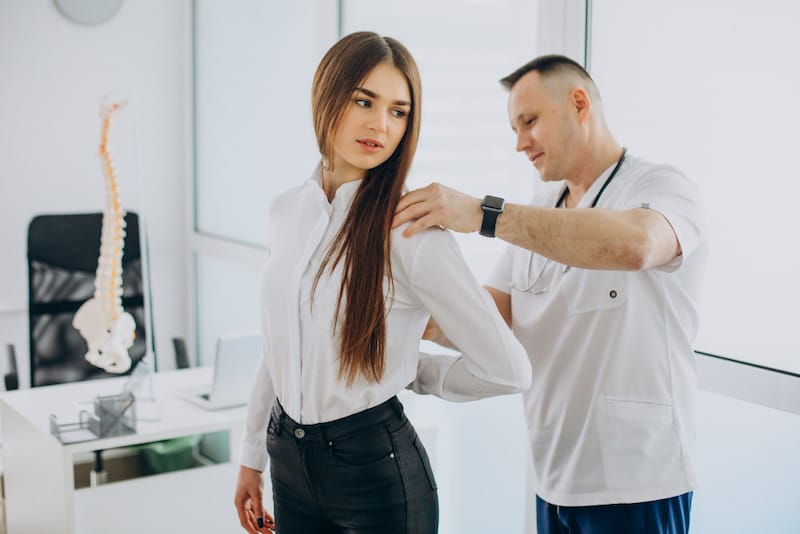
- Scoliosis – This condition refers to the abnormal curvature of your spine. This curve will cause parts of your body to adjust to fit the curvature, thereby shifting the form of the ribs slightly.
- Trauma – Even a tiny break or sprain can cause your uneven ribs. You might not even notice the injury much at the moment since minor injuries are painless most of the time, but later on, you might realize that one rib is sticking out more than the other.
- Muscle weakness – A large part of your abdominal muscles are connected between the ribcage. Therefore, if one side of your body’s muscles is weaker than the other, it would automatically cause unevenness in a very noticeable sense.
- Muscle tightness – We usually tend to be seated most of the time. This position compresses our abdominal area and can cause it to shorten and tighten over time. Gradually this can lead to unevenness in your ribcage.
- Tietze’s syndrome – This rare condition occurs when the cartilage of the joint where your ribs attach to your breastbone is irritated. This inflammation can cause swelling, which may seem like one rib sticking out more. According to a 2018 study conducted by the US National Library of Medicine, in 70 to 80% of cases, it was concluded that only one side of the chest was involved, and the pain is located mainly around a single rib.
Other symptoms to watch out for
All the medical conditions we just went through share one common symptom of an uneven ribcage.
This can be confusing as you need to identify what condition you relate to.

To simplify this, the table below shows various other symptoms that come with such conditions to clarify what you might be going through.
| Medical conditions | Symptoms apart from one rib sticking out |
|---|---|
| Scoliosis | According to studies by the US National Library of Medicine, you can expect symptoms like a visibly curved spine, uneven shoulders, a body leaning to one side, and clothes not fitting ideally. |
| Trauma | You can expect intense pain in your chest area, especially when breathing in, tenderness, and bruising of the skin during such trauma. |
| Muscle weakness | Sharp upper back and rib pain, sudden waves of pain in your chest, and the gradual worsening of pain when engaging in a repetitive motion can be seen as other symptoms. |
| Muscle tightness | This condition has very similar symptoms to muscle weakness. So, you might have to consult a doctor to get a proper diagnosis. |
| Tietze’s syndrome | You may experience chest pain, swelling, redness, and tenderness in the affected area. |
Exercises to help even your ribs
If your ribs are only somewhat uneven, exercising might be the simplest yet most efficient home remedy you got.
The list below will guide you in selecting the best exercises that fit your comfort zone.
- Strengthening exercises – Abdominal strengthening is not only helpful in fixing uneven ribs but will be all the more useful if your rib abnormality is causing difficulties in breathing. A 2013 study confirmed that this kind of exercise increases lumbar stability, respiratory function, and vital capacity. The best exercises to support your ribcage are ab-wheel rollouts, planks, and pelvic tilts.
- Stretches – One of the best stretching exercises you could do is the dead bug arm leg raise. You can start by bending your hips and knees, making a 90-degree angle. Then you’ll need to tighten your abs. Next, pressing your lower back onto the floor, take a deep breath in. The most critical part is gradually extending your left leg to the floor, bringing your right arm over your head as you exhale. Repeat this movement by switching your arms and legs.
- Yoga poses – Yes! You heard it right. Certain yoga poses too can help you gradually fix your rib evenness. You can try out poses like the plank pose, downward dog pose, child’s pose, and cat-cow pose.
Products that can assist your uneven ribs
In today’s fast-moving world, we can find various products that cater to the recovery process of various medical conditions.
Similarly, some can help fix your ribs if they are slightly uneven, as listed below.
- Yoga wheels – These products help you reach new levels of stretching. As we already know, stretching helps decompress and expand your ribcage in a way that allows the shift of the uneven nature of your ribs.
- Foam roller – This product isn’t as effective as the yoga wheel but still earns the title as one of the best products in aiding rib abnormalities as it helps you gradually overcome your rib unevenness by providing a deep spine and ribcage stretch.
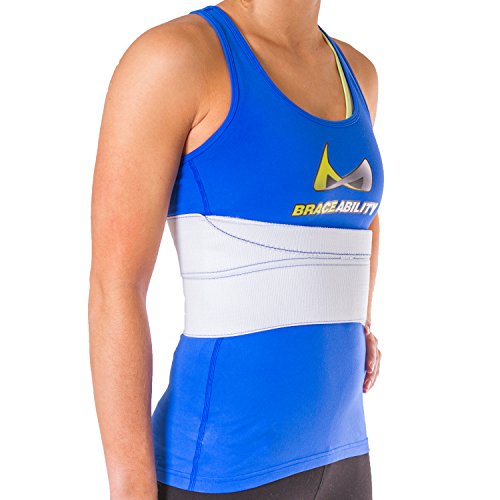
- Ribcage brace – If you’re experiencing one rib sticking out more due to a sudden injury or trauma, this would be the best option for you. This brace helps support your ribcage and will speed up your body’s recovery process.
- Inversion table – This is a useful piece of equipment to have as it allows the highest level of decompression. However, to reap its benefits, you’ll need to get in your daily workout from it without missing a day. You can start with a few minutes and extend it gradually to about 30 minutes over time.
FAQs
Can an uneven rib cage cause pain?
An uneven rib cage can cause pain in your ribs, chest, and upper back.
Since your rib cage is an essential supporter of your upper extremities and respiration, having it uneven may also lead to abnormalities in your breathing and posture.
Will you need surgery to fix rib unevenness?
The answer depends on the extent of the abnormality. If your ribcage is slightly uneven, you can gradually improve its form by exercising daily.
But if your rib cage is uneven to a severe extent, in certain instances, doctors may recommend it to be fixed surgically.
When should you seek medical attention for an uneven rib cage?
As we already know, various medical conditions can cause uneven ribs as symptoms. But most of these conditions are manageable with treatment.
Usually, a person with uneven ribs wouldn’t experience many adverse side effects.
However, if a situation arises where you might face any discomfort, pain, or distress because of an uneven rib cage, you’d need medical attention.
Conclusion
Let’s be honest. Even if your rib abnormality doesn’t quite interfere with your day-to-day activities and comfort, it can still negatively impact your body confidence when you always notice one rib sticking out more than the other.
If that is the case, you can engage in exercises at home or use different mobility tools as listed. However, it’s best not to keep to yourself if this abnormality is hindering your lifestyle or causing you any pain and discomfort.
In such cases, it’s highly advised to consult your doctor so that they can give a proper diagnosis and medically treat your condition.
Either way, you’d be achieving rib evenness within no time.